Table of Contents
ToggleIndoor gardening hit a wall for years, literally. Growers had to position plants near outlets, run extension cords across rooms, or accept that certain corners would stay green-free. Cordless grow lights changed that game completely. These battery-powered fixtures let you put light exactly where your plants need it, whether that’s a windowless bathroom, a deep closet shelf, or a kitchen island twenty feet from the nearest receptacle. No wiring, no outlet hunting, no compromises. This guide walks through what makes cordless grow lights tick, how to pick one that fits your setup, and how to use them without burning through batteries or cash.
Key Takeaways
- Cordless grow lights use rechargeable lithium-ion batteries and LED technology to deliver flexible, outlet-free lighting for indoor plants in any room or corner of your home.
- Battery capacity (measured in mAh or Wh) and spectrum adjustability are critical—choose a model with USB-C charging, dimmable controls, and output matched to your plants’ light requirements (1,500–5,000 lux).
- Position cordless grow lights 6–12 inches above plants, rotate foliage regularly for even coverage, and combine with natural light when possible to maximize growth without draining batteries.
- Extend your cordless grow light lifespan by charging between 20–80%, wiping LEDs monthly, and storing units at 50% charge in cool conditions during off-seasons.
- Cordless grow lights excel as supplemental or portable solutions for small-to-medium plant collections, renters, and flexible indoor garden setups, though they’re less suitable for high-demand crops like tomatoes or peppers.
What Are Cordless Grow Lights and Why They’re Game-Changers
Cordless grow lights are self-contained LED fixtures powered by rechargeable lithium-ion batteries instead of a wall plug. They typically include an integrated battery pack, a control panel or app for adjusting spectrum and timing, and an LED array calibrated for photosynthesis. Most run 4–12 hours per charge depending on intensity settings.
The LED portion is crucial. LEDs generate far less heat than incandescent or fluorescent bulbs and convert more electricity into usable light wavelengths, primarily the blue (400–500 nm) and red (600–700 nm) spectrums plants crave. Because they draw less power, a modest battery can run them for hours without overheating or draining fast.
Cordless models shine in scenarios where hardwired options fail. Renters who can’t modify electrical setups, designers staging rooms without accessible outlets, and growers experimenting with vertical gardens or rotating displays all benefit. They also solve the tripping-hazard problem: no cords snaking across floors or dangling behind furniture.
But they’re not magic. Battery capacity limits runtime, so these lights work best for small-to-medium plant collections or supplemental lighting rather than replacing full-spectrum setups for light-hungry crops like tomatoes or peppers. Think of them as the cordless drill of the plant world, portable, convenient, and purpose-built for specific jobs, not all-day industrial use.
Key Benefits of Going Cordless with Your Indoor Garden
Flexibility in placement tops the list. You can mount a cordless light inside a bookshelf, clip it to a rolling cart, or suspend it over a dining table centerpiece without hunting for outlets or hiding cords. This opens up design possibilities that wired lights can’t match.
Portability matters during seasonal shifts or plant rotations. If succulents need a brightness boost in winter or seedlings outgrow their starter shelf, you can move the light in seconds. No unplugging, no cord management, no furniture rearrangement.
Safety improves, especially in homes with kids, pets, or high foot traffic. Eliminating cords reduces trip hazards and removes the risk of animals chewing through wiring. Cordless lights also sidestep the overloaded-outlet problem common in older homes where every receptacle already serves a lamp, charger, or appliance.
Energy independence can be a bonus. Some cordless models pair with USB-C charging or solar-compatible power banks, letting you keep lights running during outages or in off-grid sheds and greenhouses. That’s niche, but handy for serious hobbyists.
Cleaner aesthetics appeal to anyone who’s ever fought cord clutter. A cordless fixture disappears into a shelf or planter display without visible wiring. For indoor tropical house plants or other statement greenery, that clean look can make or break the design.
The trade-off? You’re managing batteries instead of forgetting about a plug. Cordless lights demand a bit more attention, charging schedules, battery health checks, and runtime limits, but for many growers, that’s a small price for the freedom they deliver.
How to Choose the Right Cordless Grow Light for Your Plants
Not all cordless lights are created equal. Here’s how to match a fixture to your plants and space.
Battery Life and Charging Options
Battery capacity is measured in milliamp-hours (mAh) or watt-hours (Wh). A 5,000 mAh battery might run a low-power LED panel for 8–10 hours on medium brightness, while a 10,000 mAh unit could push 12+ hours. Check the manufacturer’s runtime specs at your intended brightness level, max brightness drains batteries fast.
Charging method varies. USB-C is common and convenient: you can charge from a laptop, power bank, or phone adapter. Some models include proprietary chargers or docking stations. USB-C is preferable for flexibility. Look for pass-through charging, which lets the light run while plugged in, handy if you need continuous light during a growth spurt but want cordless freedom later.
Charge time ranges from 2 to 6 hours. If you’re running lights on a daily cycle, a faster charge means less downtime. Swappable battery packs are rare but worth seeking out if you want zero interruption, charge one pack while the other runs.
Battery lifespan matters long-term. Lithium-ion batteries degrade after 300–500 charge cycles, losing capacity over time. Units with replaceable batteries extend the fixture’s useful life: otherwise, plan on diminished runtime after a year or two of heavy use.
Light Spectrum and Intensity Needs
Spectrum is the wavelength mix your plants see. Most cordless grow lights offer a full-spectrum white (mimics daylight, good for general growth) or a dual-spectrum red/blue mode (optimized for flowering and vegetative stages). Seedlings and leafy greens do fine with full-spectrum. Flowering house plants with flowers benefit from red-heavy modes during bloom.
Many current models tested by reviewers like those at CNET include adjustable color temps (3000K to 6500K) so you can tune the light as plants mature.
Intensity is measured in micromoles per square meter per second (μmol/m²/s), but most consumer labels use lux or lumens. For reference, low-light plants (house plants that need little light) thrive around 1,000–2,000 lux. Medium-light plants want 2,000–4,000 lux. High-light tropicals or flowering varieties need 4,000+ lux.
Cordless lights typically output 1,500–5,000 lux at 6–12 inches. If you’re supplementing natural light, lower output works. If the light is the sole source, pick a higher-output model and position it closer.
Adjustability is a must. Dimmable controls or multiple brightness modes let you dial in the right intensity without wasting battery. Some units include timers (4-hour, 8-hour, 12-hour cycles) built into the controller, convenient for automating light schedules without a separate plug timer.
Coverage area scales with the number of LEDs and beam angle. A 20-LED panel might cover a 12×12-inch footprint: a 40-LED bar could handle 24 inches. Match the fixture size to your planting area to avoid uneven growth or dark spots.
Best Placement Strategies for Cordless Grow Lights
Distance from canopy dictates intensity. Start with the light 6–12 inches above the plant tops. If leaves start bleaching or curling, raise it a few inches. If plants stretch (long, spindly stems), lower it or increase brightness. Adjust weekly as plants grow.
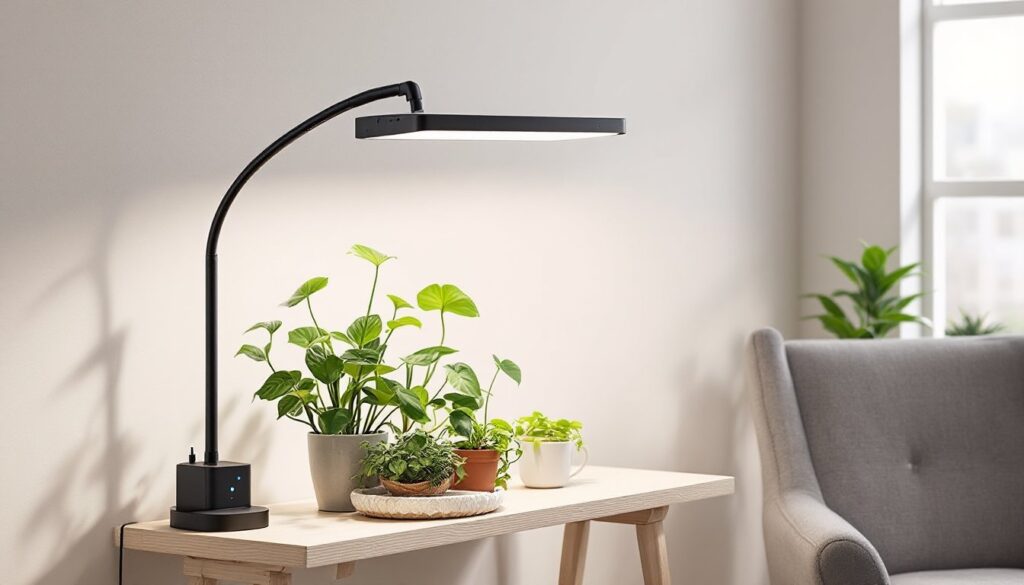
Mounting options vary by fixture. Clip-on designs attach to shelf edges or pot rims, great for single plants or tight spaces. Magnetic mounts stick to metal shelving. Freestanding tripods or gooseneck arms offer the most positioning flexibility. Whichever you choose, ensure the mount is stable. A toppled light can break or damage plants.
Uniform coverage matters for multiple plants. If you’re lighting a shelf, center the fixture or use two smaller lights at either end rather than one off-center unit. Rotate plants every few days so all sides get equal exposure, especially for dense foliage.
Avoid shadows. Place lights above or slightly angled, not directly to the side, unless you’re deliberately shaping growth. Side lighting can cause plants to lean, which is fine for training but problematic for symmetrical growth.
Heat management is rarely an issue with LEDs, but stacking multiple cordless lights in a closed cabinet can raise temps. Leave a few inches of clearance above the fixture for airflow. Don’t drape fabric or paper over active lights.
Combine with natural light when possible. Cordless lights excel as supplemental sources. A north-facing window plus a cordless fixture beats either alone. Some growers featured on sites like Gardenista use cordless lights to extend daylight hours in winter, running them dawn-to-dusk alongside ambient sun.
Mobility is a cordless advantage, use it. Shift lights to follow seasonal sun patterns, spotlight new growth, or give extra attention to struggling plants. Just keep a charging station nearby so you’re not caught with a dead battery mid-cycle.
Maintenance Tips to Maximize Your Cordless Grow Light Performance
Clean the LEDs monthly. Dust, water spots, and leaf residue block light output. Wipe the panel with a dry microfiber cloth when the unit is off and cool. For stubborn grime, lightly dampen the cloth with water, avoid soaking the fixture or letting moisture into vents or charging ports.
Manage battery health. Lithium-ion batteries last longest when kept between 20–80% charge. Avoid letting the battery fully drain repeatedly or leaving it plugged in at 100% for days. If you won’t use the light for weeks, store it at around 50% charge in a cool, dry place.
Check charge cycles. Most cordless lights include a battery indicator (LED colors or app readout). If runtime starts dropping noticeably, say, from 10 hours to 6 hours at the same settings, the battery is aging. Some warranties cover battery replacement: otherwise, budget for a new unit or replacement pack.
Inspect mounts and hinges. Clip-on arms and goosenecks can loosen over time. Tighten screws or replace worn springs before the light sags onto plants. A dropped fixture can snap stems or crack pots.
Update firmware if your model connects to an app. Manufacturers occasionally release updates that improve battery management or add features. It takes five minutes and can extend the light’s useful life.
Use the right charger. Stick with the included adapter or a certified USB-C cable rated for the light’s wattage. Cheap knock-off chargers can undercharge, overcharge, or deliver inconsistent voltage, all of which shorten battery life.
Monitor plant response. If leaves yellow, growth slows, or stems stretch even though proper light placement, the LEDs may be degrading. LED output fades slowly, after thousands of hours, a cordless light might deliver only 70% of its original intensity. Independent testing from outlets like Digital Trends shows most quality LEDs hold output for 20,000+ hours, but cheaper units fade faster. If you suspect dimming, compare the light’s performance to a new unit or test with a lux meter app (available free for most smartphones).
Store properly off-season. If you’re scaling back plants in winter or taking a break, don’t leave the light in a hot garage or damp basement. Temperature extremes and humidity degrade batteries and circuit boards. Keep it indoors, charged to 50%, and away from direct sun.